Epilepsy Awareness Month, Day 16: What’s wrong with New Jersey?!

I see an ad on Facebook occasionally from the Epilepsy Foundation of Minnesota and onein26.org. A few days ago, someone left a comment there lamenting the fact that if someone has cancer, heart problems or diabetes, people want to help out. When they hear “epilepsy” or “seizures”, it’s “RUN FOR THE HILLS!” (Okay, maybe not that bad, but it’s certainly not the same level of empathy.)

I can understand why, really. Epilepsy and seizures are kinda scary. You can be having a conversation with someone, then suddenly, they collapse onto the floor, flopping around like a fish and knocking lamps off the tables. And a lot of times, that’s the only thing they know when they hear “seizure”. Not many people realize that there are over forty kinds of seizures and they only know about one of ’em.

What’s more, there’s nothing concrete about it. You can’t just point your finger at something and say, “That’s epilepsy, here’s how to fix it.” If someone has cancer, “There’s the tumor, time for chemo and radiation.” Heart disease? “There’s the blockage, time for bypass surgery.” Diabetes? “Good God, man, start drinking coffee with your sugar!” And then there’s epilepsy.

About 60% of the time, doctors can’t find a cause. It just happens. Everything is fine, then you have a seizure. And more than half the time, you also have a lot of unanswerable questions. I’ve had a handful of MRIs done on my head and my brain looks quite healthy, thank you very much. We don’t know why my left temporal lobe sometimes acts like an 8-year-old after stealing his father’s coffee mug filled with sugar, but it does.

Look at it this way: with all of the gajillions of neurons in the brain, it’s like a network of all of the computers in the United States. Everything runs smoothly, all of the computers function as a single unit to perform all of the necessary functions and it doesn’t matter that 2/3 of them are constantly surfing for porn on the Internet.

And then one day, when everything is running smoothly, there’s one bad batch of code in New Jersey. Just a few ones and zeros in the wrong order and there’s an instant chain reaction that shoots through the entire network and all of those smoothly-running computers are now stuck on the blue screen of death for thirty seconds. And then it stops, the computers all reboot and everything is running smoothly again.

Obviously, this isn’t how all seizures happen or how much of the brain they affect. Sometimes it’s a nation-wide disaster scenario. Sometimes it makes the monitor screens in a small neighborhood flutter for a few seconds. Sometimes it’s a massive blackout across the entire state of New Jersey. All because of one bad batch of code that repeats itself from time to time… but no one knows when it’ll happen or how often.

How do you treat epilepsy? It might go away on its own, but a lot of people take medication. Types and quantities vary, side effects vary and success rates vary as well. I think I’ve been on… eight different meds at different times. There were two that kept me seizure-free for almost fifteen years, but since then? Time to get out the dartboard, throw a dart and see which medication I start next!

Or some people have brain surgery. If you think open heart surgery or removing tumors is scary, imagine extracting the entire state of New Jersey from your head. How does that affect someone’s personality? Aside from the existential question of “Am I still me if I have part of my mental capacity removed?”, you just lost a big chunk of the eastern coastline. (For the record, I know several people who’ve had brain surgery and they’re doing just fine. No mental or emotional scars, just the physical ones on their head from the incision.)

So there are a lot of unknowns about epilepsy. Who, what, where, when, how and why? We know the who and the what: one in 26 have epilepsy. There’s usually no where or when until after a seizure happens; how they happen or why? Not many answers there, either. And without answers, people think it’s scarier than things that kill a lot more people. Things like cancer, heart disease and diabetes.

But it doesn’t have to be scary. More research is constantly being done for different kinds of treatment: different medications, different surgeries, different implants (you may be able to keep New Jersey on your neural map). They can limit or prevent seizures altogether. They can help people function on a daily basis. They can allow those of us with epilepsy to live relatively normal lives. That’s the hope, anyway.

And I think that’s the point of Epilepsy Awareness Month. Talking about it, learning about it, realizing that it’s not as scary as you might think. Sure, sometimes people with epilepsy break lamps, but I was in a play when it happened. I was supposed to bump it with my arm when I ran past, then grab it before it fell… oops. (Thankfully, we had a backup lamp for the remainder of the shows.) So there can be lamp casualties, but that doesn’t change the fact that we’re not that scary.

We’re one in 26. We have epilepsy. And we’re pretty awesome people, too.

Epilepsy Awareness Month, Day 11: Par for the course

I had originally written the title as “Just another day”, but I think it’s important to acknowledge that epilepsy awareness is pretty dang significant. It’s like Veterans’ Day or Black History Month or any unit of time that deserves a title with capital letters. People who have epilepsy shouldn’t be marginalized or forgotten or ignored. We’re special… maybe not in a good way, but still special.

I thought about “just another day” because it’s also a way of life for us, something that we deal with every day. Something that I deal with every day. And twice a day when I take my medications, too. (I’d say “morning” and “night”, but as long as I take them at least six hours apart, I’m happy. And for the record, a lot of people don’t have that luxury.)

It just seemed to resonate today because I’m having flashbacks to about 18 years ago. That was a time when my seizures were uncontrolled. Infrequent, but still uncontrolled. Every once in a while, I’d have a blackout. No triggers that caused them, no sensation that it was about to happen. I’d just walk into the kitchen and then I was walking out with a plate of eggs and toast for breakfast. Or watch a Vikings game and then it was ten minutes further into the game and the scoreless tie was 7-0. Or I’d be doing something unimportant and then I was in the middle of a conversation with my mother and only stopped talking because I couldn’t remember the word “chart”. I could think of the lines going up and down and side to side, but not the word. And that was par for the course. I got used to them.

But it’s not like we sat back and let it happen. I was “medication hopping” for a while. We tried a variety of different combinations and doses of medications back around 2000-01. I don’t remember all of them, though I recall taking Trileptal and the doc eventually increased it to a toxic dosage. He thought it would be okay because “I was a big guy”, but the seizures kept happening. So we tried another. And another.

Thankfully, after a stay in the epilepsy ward of United Hospital, the doctors found the right combination. (They glued a bunch of electrodes to my head to find where the excess electrical activity was, then picked medications to address that.) And for fifteen years, that became par for the course.

And then it wasn’t anymore. My body started getting acclimated to those medications and I had to try something else. And I was scared. There was some combination in the early 2000s that really messed with my head. My long-term memory suffered. A lot. And so I was scared. I was about to try a new kind of medication and I didn’t know what that would do to me. Would I forget more things from my past? Would my behavior change? Would I still be… me? Thankfully, Teresa was there to comfort me that night because I did a lot of crying. Because I was scared.

I’m not scared now. I’ve done some more medication hopping since last year, but to no avail. Well, not complete avail. Certainly not “fifteen years with no seizures” avail. But really, not even “I can tolerate this level of seizures in the long term” avail. I’ve got an appointment scheduled with my doctor at Minnesota Epilepsy Group at the end of the month and we’ll talk about a different type of treatment. Maybe a different dosage of what I’m taking, but probably a different medication altogether. And I’m not crying this time. I didn’t any of the other times we’ve made medication changes since last year, either. Because I’m still me, I’m still functional and I’m still able to talk about having epilepsy and seizures. I was afraid of starting medication hopping all over again, but now? Now it’s par for the course.

Epilepsy Awareness Month, Day 8: Wedding plans

I know, it’s been a few days since I’ve written something. But here’s a little story to go with it.

This summer, I spent two days helping at Camp Oz, a week-long camp created for kids with epilepsy. Because, you know, having an unexpected seizure while playing capture the flag at a regular summer camp can get a little awkward.

When I talked about volunteering there, someone told me about another adult helper a while back who was talking to one of the kids. The kid was lamenting the fact that because he had epilepsy, he was never going to get married. As it turned out, the volunteer (who also had epilepsy) was married, so he got to console the kid. Having epilepsy doesn’t mean you’re doomed to suffer a life of loneliness and isolation.

Why is this relevant? Because as soon as Teresa gets home, we’ll be putting wedding invitations into envelopes so they can be mailed out to people on our guest list. Stuff like this can get tedious at times, but it also shows that one more person with epilepsy can and will be getting married in a few months. You’re welcome, kid.

Epilepsy Awareness Month, Day 3: One in 26

For my first post for Epilepsy Awareness Month last year, I wrote about onein26.org. It was an ad campaign developed by the Epilepsy Foundation of Minnesota to create awareness about epilepsy and how common it actually is. The header for the website is a video that I got to be a part of and I’m pretty proud of that fact. They also posted the video on YouTube, which means I can post it here on the blog. Not to say that you shouldn’t visit the website, but if you only have a minute of spare time…

What I discovered later is that the company that created this video made another one using additional footage from some of the same people and entered it into a kind of advertising campaign competition. I’m not sure what the name of the competition is, how the video got entered, what the rules were… I just know it won a bronze award in the “Integrated Media Public Service Campaign” category. I’m pretty proud of that fact, too. Unfortunately, it’s not on YouTube, so I can’t embed the video on this page, but I can add a link to the site where it’s posted. So without further ado…

We are ONEin26

Epilepsy Awareness Month, Day 2: What are my seizures like?

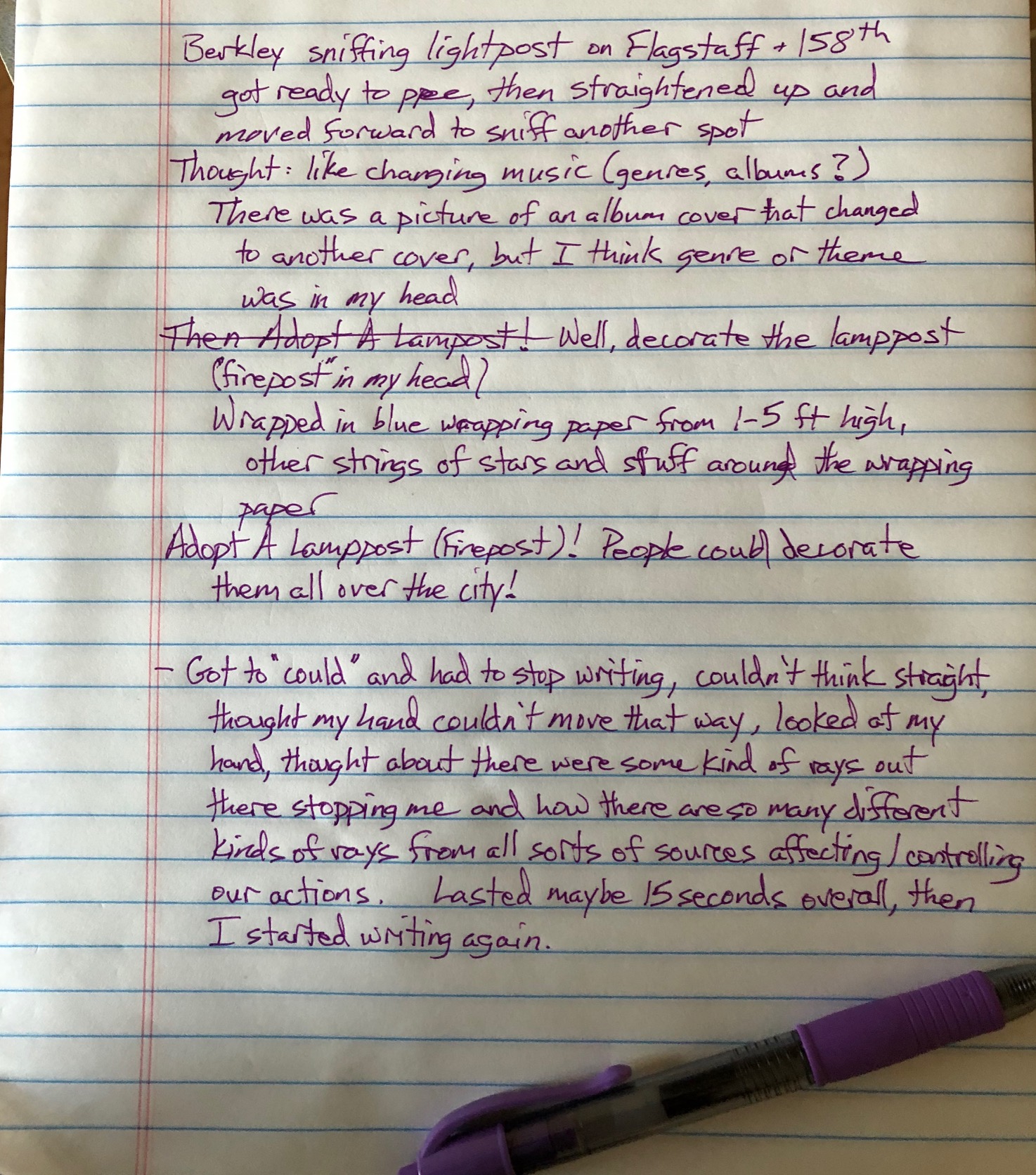
When you hear “epileptic seizure”, what’s the first thing that pops into your mind? For a lot of people, it’s an image of someone losing consciousness, falling to the floor and thrashing around violently. It’s understandable. But that’s only one kind of seizure. What many people don’t realize is that there are over 40 different types.

This morning, I brought the dogs outside for a quick walk before work. I usually let Sophie do her business, bring her back inside, then Berkley and I go back out for a longer walk. My head felt a little weird when we left the house the first time, but it wasn’t until Berkley and I headed down the block that stuff definitely started happening.

I think the most unusual part is that in the past, when I’ve had seizures and strange things popped into my head like this, they were there and then gone. “Now you see me, now you don’t!” Whatever it was that I was thinking… poof! Don’t need to worry about that thought process ever again.

But this one image during our walk stayed. I was able to cling to it, remember it, and I kept thinking about it until we got home. I had recently started keeping a seizure journal on my phone just to get an idea of how often they’ve been happening recently, but I was also including other details: what happened, how long it lasted, how it felt, etc. The fact that I was able to remember that image, that thought process from the walk… I wanted to jot down some notes about my seizure as soon as we got back.

So this happened: